









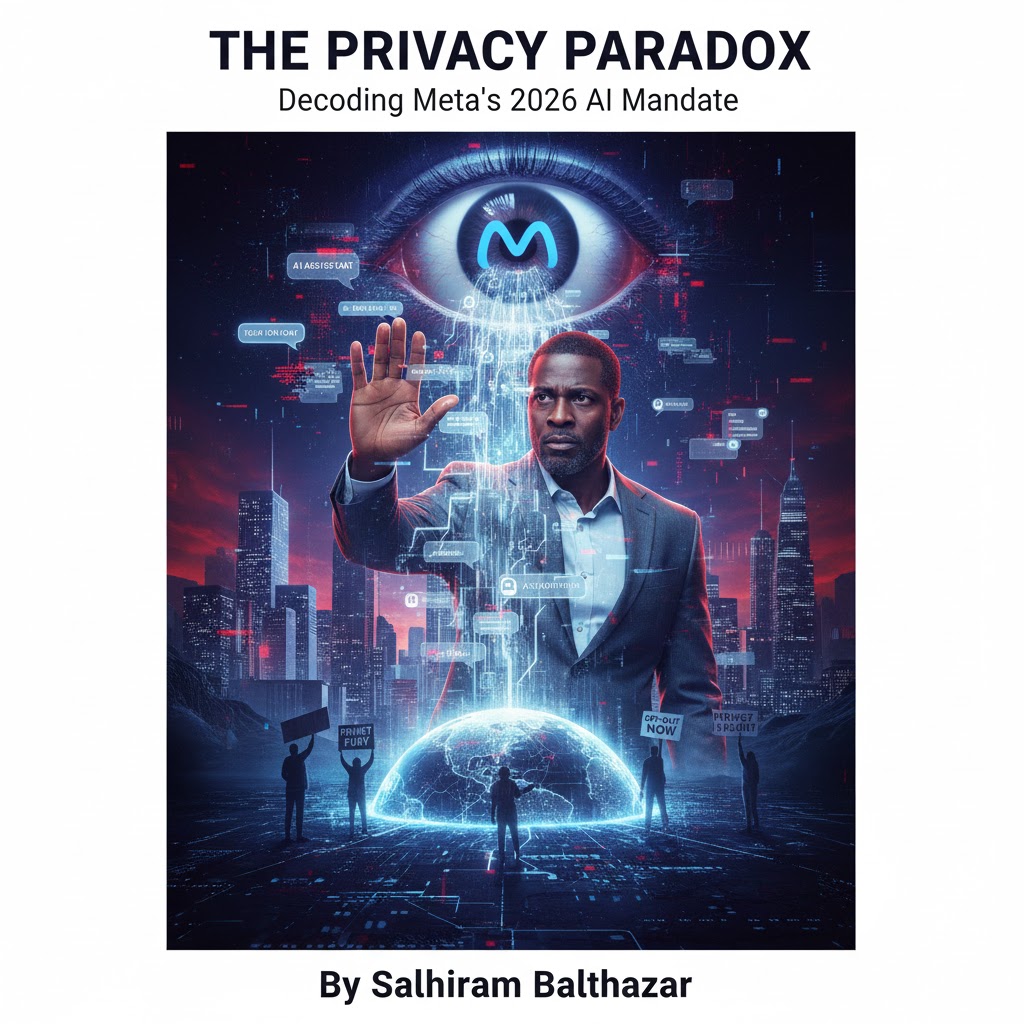
By Salhiram Balthazar NEW YORK – As a brand marketing specialist, I’ve spent my career helping companies find the “sweet spot” between data-driven utility and consumer trust. But as we cross into 2026, that sweet spot is becoming a battlefield. The recent headline from WebProNews regarding Meta’s 2026 AI policy update isn’t just another tech-cycle news story; it’s a fundamental shift in the social contract between platforms and people.
Meta’s decision to integrate AI directly into private chats across Facebook, Instagram, and WhatsApp—and more importantly, to use those interactions to fuel its ad engine—is the boldest move we’ve seen in a decade. From where I sit, this is a masterclass in aggressive brand scaling, but it’s also a high-wire act that could permanently alienate the modern, privacy-conscious consumer.
The Core of the Controversy: Conversations as Commodities
The 2026 policy, which took full effect in late December 2025, essentially turns every interaction with “Meta AI” into a data point for behavioral targeting. Whether you’re asking the assistant for a travel itinerary in WhatsApp or brainstorming gift ideas on Instagram, those inputs are now being harvested to refine what you see in your feed.
From a marketing perspective, the logic is flawless. For years, we relied on “proxies” for intent—what you liked, who you followed, or what you clicked. Now, Meta is going straight to the source: intent-based conversation. If you tell an AI you’re feeling burnt out and need a vacation, you aren’t just getting a suggestion; you’re triggering a multi-billion-dollar algorithm that will serve you flight deals and luxury spa retreats before you’ve even closed the chat.
But here is the specialist’s dilemma: Just because we can target, does it mean we should?
The “Encryption” Illusion
Meta has been careful to clarify that “private messages” remain end-to-end encrypted. However, the distinction they are making is a fine one: while the person-to-person chat is locked, the person-to-AI interaction is treated as a separate, analyzable data stream.
To the average user, this feels like a technicality. If I am chatting in a WhatsApp window, I perceive that space as “private.” When the AI joins that space, the psychological boundary of privacy remains. By monetizing those AI interactions, Meta is effectively placing a “listening device” in the one area users previously felt was off-limits. As a brand specialist, I know that once you break a user’s “spatial” trust, it is incredibly difficult to earn back.
The Rise of Political Micro-Targeting
One of the most alarming aspects of this policy, as noted in recent reports, is the potential for political ad targeting. While Meta claims to exclude “sensitive” topics like health and religion, the nuances of political discourse are much harder to filter.
If a user discusses economic concerns or social policies with an AI assistant, that data can be used to profile their political leanings with terrifying accuracy. In a 2026 landscape where deepfakes and AI-generated misinformation are already rampant, using “private” AI chats to sharpen political targeting feels like pouring gasoline on a fire. For brands, being associated with a platform that is seen as “manipulative” rather than “helpful” is a massive reputational risk.
The Specialist’s Perspective: Utility vs. Intrusion
As Salhiram Balthazar, I always ask: What is the value exchange?
Meta defends this policy by pointing to the “value-adds.” AI-generated content summaries, real-time translations, and proactive assistance are genuinely useful features. For many users, the convenience of an all-knowing assistant outweighs the nebulous fear of data harvesting.
However, we are seeing a growing “Privacy Fury” because the opt-out mechanisms are notoriously difficult to navigate. In 2026, “Transparency” is no longer enough; we need “Agency.” A brand that forces a user into a data-sharing agreement via a “silent opt-in” might win on short-term metrics, but it loses on long-term Brand Equity.
The Regulatory Storm on the Horizon
We are already seeing the fallout. Privacy advocates and groups like EPIC (Electronic Privacy Information Center) are calling for FTC intervention. In the EU, the Digital Services Act is being invoked to question whether Meta’s “separate treatment” of AI chats violates the spirit of data protection laws.
For marketers, this means the ground is shifting. If you build your 2026 strategy around these hyper-specific AI-derived audiences, you might find your campaigns shut down by a sudden court injunction or a change in regional law. Reliance on “invasive” data is a brittle strategy.
Three Takeaways for Brands in the Meta-AI Era
If you are navigating this landscape alongside me, here is how I suggest we move forward:
- Prioritize First-Party Data: Don’t rely solely on Meta’s “AI-derived” insights. Build your own direct relationships with customers so you don’t have to depend on a platform’s controversial data practices.
- Lean into Ethical Personalization: Use AI to make the customer’s life easier, not just to sell them more. If your brand is perceived as a “helper” rather than a “stalker,” you will survive the privacy backlash.
- Advocate for Clear Consent: As brand specialists, we should push for platforms to provide clear, one-click opt-ins. A customer who chooses to share their data is 10x more valuable than one who is being tracked against their will.
Final Thought
Meta’s 2026 AI policy is a turning point. It represents the ultimate victory of “Big Data” over “Small Privacy.” But as history shows, when the pendulum swings too far toward intrusion, the market eventually swings back toward anonymity.
In 2026, the brands that win won’t be the ones with the most data—they’ll be the ones that the customers still trust after the data is harvested. The “Fury” reported by WebProNews is a warning shot. We would do well to listen.



Hey there I am so excited I found your site, I really found you by mistake, while I was looking on Google for something else, Anyways I am here now and would just like to say many thanks for a marvelous post and a all round enjoyable blog (I also love the theme/design), I don’t have time to read it all at the moment but I have book-marked it and also included your RSS feeds, so when I have time I will be back to read much more, Please do keep up the superb job.