











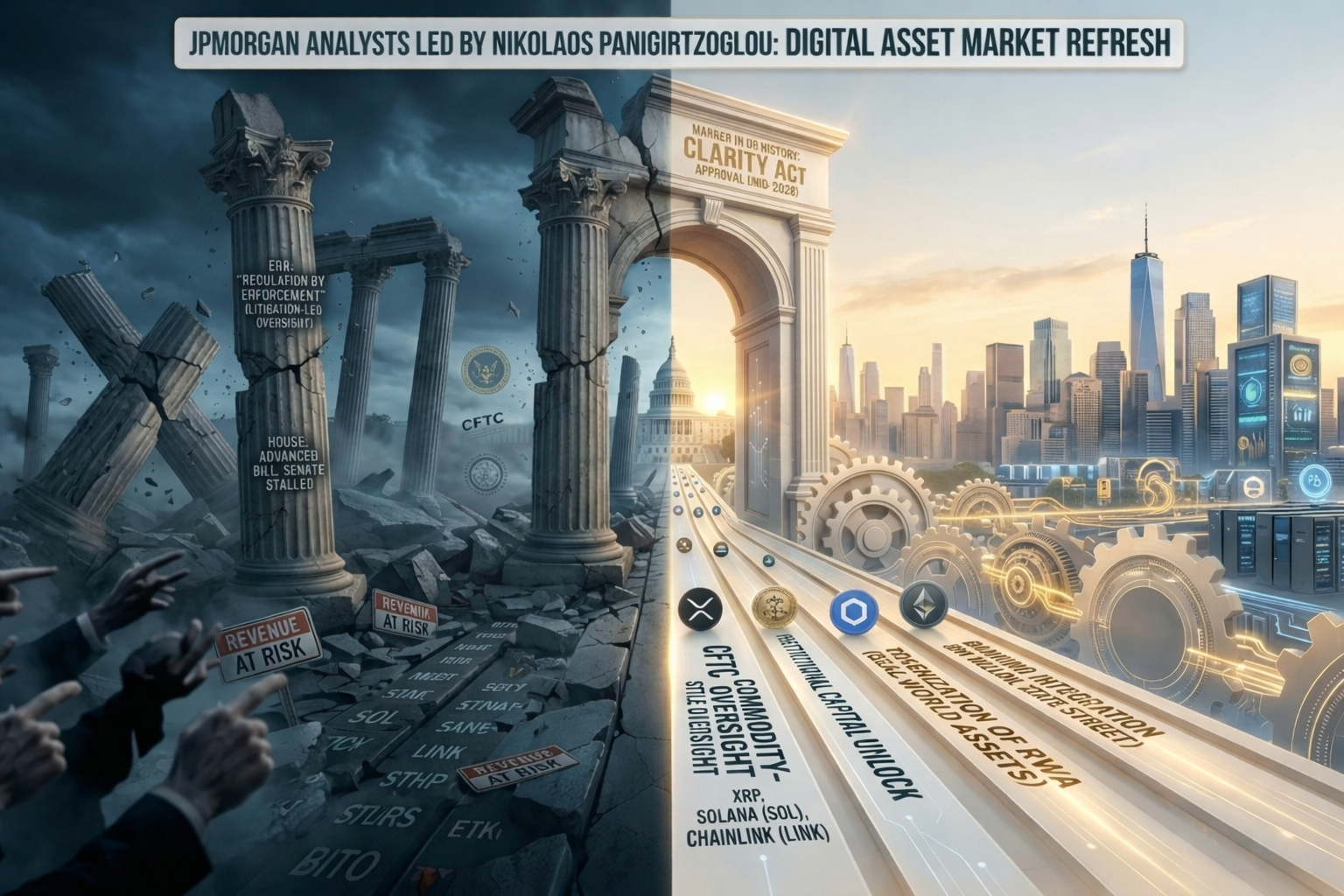
For years, the American digital asset sector has operated in a state of “strategic ambiguity.” Innovation has often been met not with guidance, but with litigation. However, according to recent insights from JPMorgan analysts led by Nikolaos Panigirtzoglou, we are standing on the precipice of a historical correction. The potential mid-2026 approval of the CLARITY Act (and associated market structure legislation) represents more than just a new set of rules; it is a foundational marker in U.S. economic history that will redefine how value is moved, stored, and branded on a global scale.
1. The End of the “Wild West” Era
Since the inception of Bitcoin, the U.S. regulatory approach has been characterized as “Regulation by Enforcement.” Without specific laws passed by Congress, agencies like the SEC have relied on decades-old precedents—most notably the Howey Test from 1946—to govern 21st-century code.
The CLARITY Act seeks to dismantle this fragmented approach. By establishing a clear legal framework, the U.S. is finally signaling that digital assets are a permanent fixture of the sovereign economy. For the first time, we are moving away from the “move fast and break things” ethos of early crypto and into a “build to last” institutional era. This shift is the ultimate “brand refresh” for the United States, positioning it once again as the primary hub for financial technology innovation.
2. Dual Agency Oversight: SEC vs. CFTC
One of the most significant structural changes within the legislation is the formal division of labor between the Securities and Exchange Commission (SEC) and the Commodity Futures Trading Commission (CFTC).
For years, the industry has been paralyzed by the question: Is it a security or a commodity?
- The Conflict: If a token is a security, it faces rigorous disclosure and registration requirements. If it’s a commodity, it enjoys the more flexible oversight typical of gold or oil.
- The Solution: The new legislation provides a specific criteria to classify assets. Major tokens like XRP, Solana (SOL), and Chainlink (LINK) could find themselves under the CFTC’s commodity-style oversight, significantly reducing compliance burdens.
For a Brand Marketing Strategist, this is crucial. When the “legal product category” of an asset is defined, the marketing and adoption of that asset can finally scale. Uncertainty is the enemy of investment; clarity is the catalyst for growth.
3. Unlocking the Institutional Floodgates
Perhaps the most significant economic impact of this legislation is the “Institutional Unlock.” Currently, massive pools of capital—pension funds, insurance companies, and corporate treasuries—are sitting on the sidelines. They aren’t avoiding digital assets because they don’t see the value; they are avoiding them because their compliance departments won’t allow them to touch “unregulated” instruments.
The CLARITY Act provides the “Green Light” these institutions need. When major banks like BNY Mellon and State Street are empowered to directly custody digital assets, the friction of entry vanishes. We aren’t just talking about retail investors buying Bitcoin on an app; we are talking about the bedrock of the global financial system integrating blockchain into their balance sheets.
4. The Tokenization of Everything (RWA)
Beyond simple trading, this legislation accelerates the Tokenization of Real-World Assets (RWA). This is where the true economic revolution lies. Tokenization involves taking a physical or traditional asset—like real estate, private equity, or US Treasuries—and representing it as a digital token on a blockchain.
Why this matters for the U.S. Economy:
- Liquidity: Assets that were previously “illiquid” can now be traded 24/7 in fractional amounts.
- Efficiency: By removing intermediaries and using smart contracts, the cost of title transfers and settlements drops significantly.
- Transparency: A public, immutable ledger reduces fraud and increases trust in the valuation of assets.
As we look toward the second half of 2026, the branding of “Digital Assets” will shift from “speculative coins” to “digital representations of real-world value.”
5. Strategic Implications for Brand Strategy
At Heru Vision Consulting, we understand that a brand is only as strong as the trust it commands. For a decade, the “Crypto Brand” has been marred by volatility and high-profile collapses.
The CLARITY Act is the regulatory “seal of approval” that repairs this brand equity. It allows companies to market digital asset services with the same authority as traditional fintech or banking services. As a Brand Marketing Strategist, this tells me that the next wave of successful companies won’t be those promising “to the moon” returns, but those promising compliant, transparent, and integrated financial utility.
6. The Hurdles: A Stalled Senate
Despite the optimism, the road to mid-2026 isn’t without obstacles. While the House of Representatives has shown momentum, the bill currently sits in the Senate Banking Committee. According to Baker McKenzie, the momentum slowed in early 2026 due to industry disputes over the revised text.
The sticking points include:
- Stablecoin Yields: Crypto firms want to pay “yield” on stablecoins, but traditional banks argue this could siphon trillions in deposits from the traditional banking system.
- Conflicts of Interest: Ensuring government officials and major stakeholders don’t have unfair advantages in this new system.
These are not just “legal hurdles”; they are the final debates in a historic negotiation over the future of the American Dollar’s digital form.
Conclusion: A Second-Half Catalyst
JPMorgan’s report isn’t just a price prediction—it’s a roadmap for the next evolution of the American economy. If the CLARITY Act passes, the second half of 2026 will be remembered as the moment the U.S. reclaimed its mantle as the leader of the digital frontier.
For businesses and investors, the message is clear: The framework is coming. The “Wild West” is being settled, and the “Digital Gold Rush” is evolving into a structured, institutionalized, and highly efficient digital economy. The question isn’t whether you should participate, but how you will brand your presence in this new era.

This was an insightful article. We anticipate that the forthcoming XRP correction will accurately reflect its intrinsic value. Bitcoin accumulation remains paramount, irrespective of market volatility. We recommend securing your hardware wallet and private keys in a safe, as this embodies true ownership.
Definitely, a lot of people have reported that they have lost their assets due to private keys being lost.
Pingback: The Digital Gold Rush Meets The CLARITY Act: Taming the Crypto Frontier - Heru Vision Consulting