










By Salhiram Balthazar Brand Marketing Strategist, Heru Vision Consulting
WASHINGTON D.C. — As we navigate the start of February 2026, a significant legal development has surfaced that touches the lives of hundreds of thousands of people within our community. On February 2nd, a federal judge in Washington D.C. issued a ruling that directly impacts the lives of roughly 350,000 Haitian nationals, as reported by The New York Times.
As a Haitian-American and a U.S. citizen, I believe it is essential to look at the facts of this ruling with a clear lens—beyond the headlines and the noise. Whether you are a business owner, a community leader, or a family member, understanding the “why” and “what’s next” is vital for our collective stability.
The Facts of the Ruling TPS for Haitian
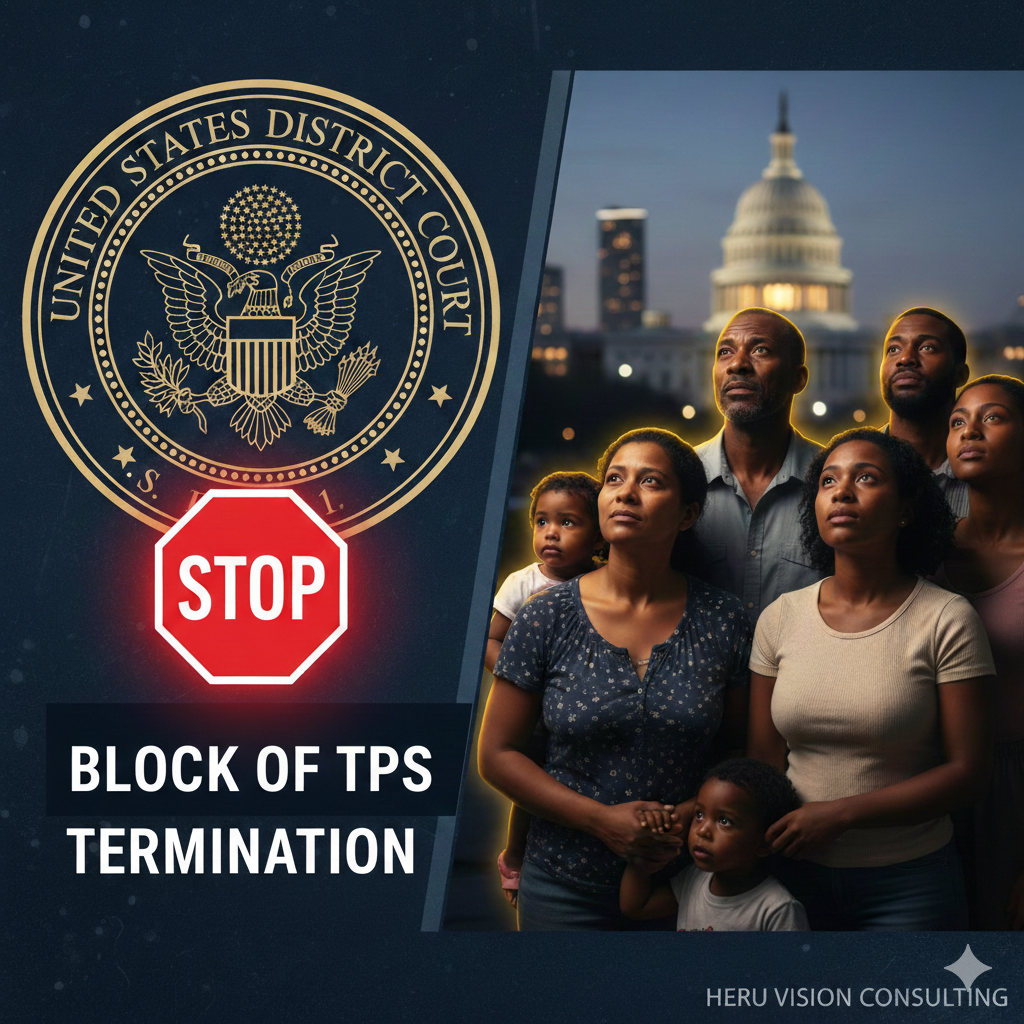
The administration had previously announced a plan to end Temporary Protected Status (TPS) for Haitians, with an expiration date set for February 3, 2026. However, U.S. District Judge Ana C. Reyes stepped in, granting a preliminary injunction that halts that termination.
This means that, for the time being, the status of those 350,000 individuals remains intact. Their work authorizations and legal protections from deportation are preserved while the legal process plays out in court.
Understanding Both Perspectives
To maintain a transparent view of where we stand as a nation, it is helpful to look at the two arguments currently meeting in the courtroom:
- The Government’s View: The administration’s position is based on the “temporary” nature of the program. They argue that the conditions which originally triggered the TPS designation have changed and that the executive branch holds the authority to decide when a program has met its end.
- The Community Advocates’ View: On the other side, advocates and legal teams argue that the current landscape in Haiti—marked by significant security and humanitarian challenges—does not yet allow for a safe return. They also contend that the decision to end the program didn’t follow the proper legal “playbook” required by federal law.
Why This Matters for Brand and Business
In my work at Heru Vision Consulting, I often talk about the importance of stability and the human element in any organizational strategy. This ruling isn’t just about policy; it’s about people who are integral parts of our workforce and our local economies.
When 350,000 people are granted a reprieve, it means businesses keep their employees, families keep their breadwinners, and the marketplace maintains a level of predictability that was nearly lost this week.
Looking Ahead
While this is a significant moment, it is also a temporary one. The government is expected to appeal, and the case will likely move to higher courts. For now, the “stop” button has been pressed, providing a window of time for families to plan and for the legal system to take a deeper look at the facts.
As a community, we remain observant. Knowledge is our best tool for navigating these shifts, and I will continue to keep an eye on how these developments affect our people and our professional landscape.