










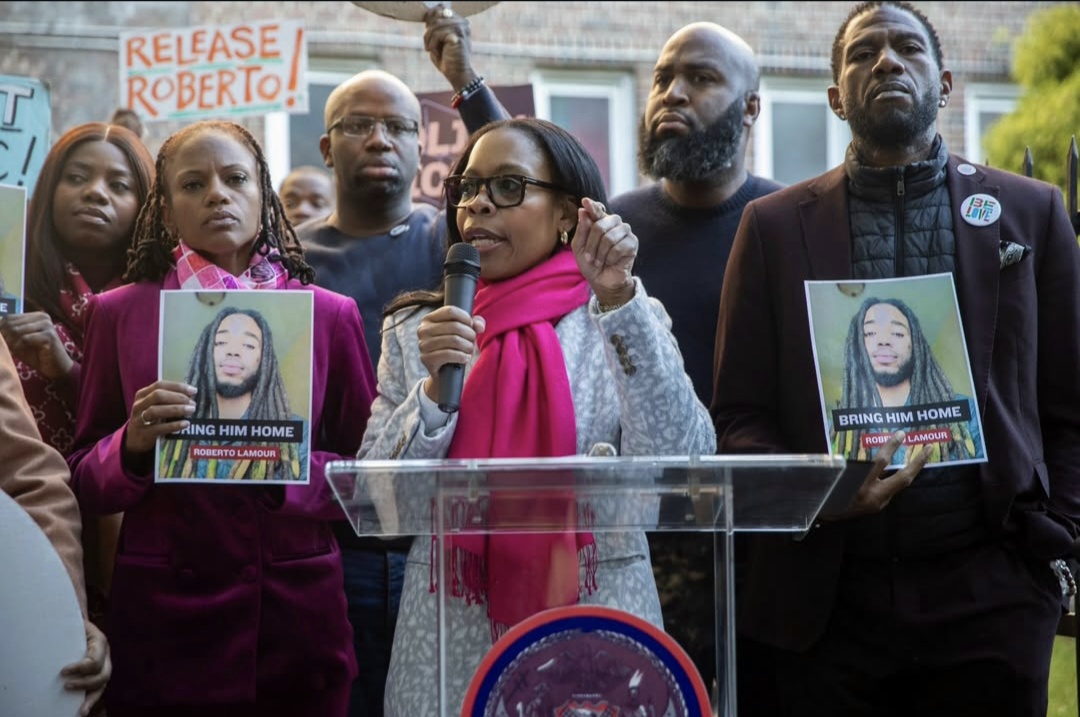
When navigating times of uncertainty and crisis, community strength rests on two pillars: the enduring spirit of its people and the courage of elected officials and advocates who step up to fight for them. For New York City’s Haitian diaspora—particularly across central Brooklyn neighborhoods like Flatbush, Prospect Lefferts Gardens, Ditmas Park, and Crown Heights—hard times have never been a signal to yield. Instead, difficult moments have always served as calls to action, community organizing, and policy advocacy. Recent events, such as the heartbreaking detention of Roberto Lamour—a Haitian father, community member, and neighbor whose story sparked widespread community concern—underscore the intense vulnerabilities facing immigrant families today. When news of Roberto Lamour’s detention reached the neighborhood, Council Member Rita Joseph joined forces with local residents, community members, and public advocates to demand justice and his release.
Emigrating from Haiti to Brooklyn as a child, Council Member Rita Joseph carries a story that reflects the journey of thousands of working families who built new lives in New York while keeping their hearts firmly rooted in Haiti. From her early days as a community activist organizing youth rallies against discrimination to her tenure as a public school teacher and Chair of the City Council’s Committee on Education, her career exemplifies how personal devotion turns into real legislative and community protection.
In moments of geopolitical hardship, shifting immigration enforcement, and local economic strain, stories like Roberto’s show why hyper-local governance and municipal policy are so critical. Council Member Joseph’s advocacy offers a clear blueprint for standing up for vulnerable neighbors and turning community hardship into meaningful action.
A Legacy Grounded in Grassroots Activism
To understand Rita Joseph’s commitment to her constituents, one must examine her long history as an organizer. At just 19 years old, she co-founded Haitian Enforcement Against Racism (HEAR) and helped rally over 150,000 people to march across the Brooklyn Bridge. That historic mobilization successfully pressured federal authorities to revoke discriminatory FDA policies targeting Haitian blood donors.
That early victory established a foundational principle: community organizing is the engine that drives policy and protects civil rights.
When unexpected immigration detentions—like the situation involving Roberto—create fear and distress, community members often feel isolated within massive, complex federal systems. Having leaders who developed their skills in grassroots movements ensures that local offices immediately transform into emergency support hubs, rallying neighbors, coordinating public advocacy, and raising visibility for impacted families.
┌────────────────────────────────────────────────────────────────────────┐
│                   THE ARCH OF COMMUNITY ADVOCACY                       │
├────────────────────────────────────────────────────────────────────────┤
│ Grassroots Organizing ──► District Action ────► City-Wide Policy       │
│ • Youth Mobilization      • Constituent Defense  • Education Funding   │
│ • Civil Rights Rallies    • Housing Aid         • Immigrant Protections│
│ • Case Advocacy          • Resource Nav.       • Language Access     │
└────────────────────────────────────────────────────────────────────────┘
Local Policy as a Shield in Hard Times
While national headlines focus on broader policy shifts and international instability, the real daily impact falls directly on local families. When a parent or breadwinner faces immigration detention, families face immediate and overwhelming challenges: legal defense costs, housing instability, school disruptions for children, and emotional trauma.
Here is how municipal policy, community organizing, and dedicated representation work together to support families through crisis:
1. Funding Immigrant Legal Defense and Defense Services
In periods of aggressive immigration enforcement, municipal support provides a vital legal safety net.
- Funding Legal Services: Pushing for robust city budget allocations for immigrant legal defense organizations ensures that low-income workers and detained individuals, like Roberto, have access to legal representation for status adjustments, stay-of-removal petitions, and bond hearings.
- Constituent Support Hubs: District offices act as trusted initial points of contact where families can safely seek legal referrals, access emergency assistance, and navigate complex city agencies without fear.
2. Educational Equity and Child Stability
When families face traumatic events like detention, children’s schooling and well-being must be safeguarded. As Chair of the Council’s Education Committee, Rita Joseph approaches public education as both a fundamental right and a community sanctuary.
- Culturally Responsive Support: Pushing for bilingual staff, Haitian Kreyòl dual-language options, and English Language Learner (ELL) resources ensures that youth remain supported in their education.
- Trauma-Informed School Services: Expanding mental health and social work resources directly within community schools helps children navigate family crises and emotional stress safely.
3. Housing Security and Tenant Protections
Brooklyn’s working-class immigrant communities face high living costs and gentrification pressures, which compound when a household member is detained.
- Preventing Unlawful Evictions: Legislative backing for right-to-counsel initiatives and free legal services protects vulnerable families from facing illegal evictions during emergency situations.
- Neighborhood Stabilization: Supporting affordable housing programs ensures that immigrant families who helped build these neighborhoods are not displaced during periods of financial or legal strain.
The Power of Participatory Budgeting and Direct Engagement
A true measure of a representative’s devotion to their district is how directly they involve the public in decision-making. Through initiatives like Participatory Budgeting, Council Member Joseph invites residents—including youth, immigrants, and long-term workers—to decide directly how public capital funds are spent within District 40.
| Focus Area | Policy Objective | Direct Community Impact |
|---|---|---|
| Public Schools | Capital upgrades for technology, libraries, and classroom spaces. | Delivers equitable learning environments for immigrant and working-class youth. |
| Community Spaces | Upgrading neighborhood centers, local parks, and public gathering sites. | Creates safe, accessible places for families, youth, and elders to gather, organize, and support one another. |
| Street Safety & Infra | Traffic calming, lighting improvements, and public sanitation investments. | Enhances neighborhood safety, improves quality of life, and supports local small businesses. |
By putting budgeting power directly in the hands of residents, local governance fosters deep civic trust and empowers community members to shape their own surroundings.
A Vision Built on Long-Term Hope and Solidarity
The history of the Haitian people—from winning independence in 1804 to leading modern civil rights movements across New York—demonstrates that true resilience is active and organized.
Hard times and sudden crises will inevitably test our communities, but they do not dictate the end of the story. When sudden emergencies arise—such as the detention of Roberto Lamour—public servants like Rita Joseph, alongside dedicated local residents, remind us of what solidarity looks like in action. By standing up for detained neighbors, expanding legal defense resources, defending tenants, and ensuring our public schools remain safe havens, local advocacy transforms hardship into enduring strength.
“Grounding ourselves in community, guided by a vision for a more just and inclusive city, ensures that no matter how difficult the storm, our people will always have a path forward.”
As we look toward the future, the message remains clear: through community solidarity, local policy action, and persistent advocacy, the diaspora continues to rise above every challenge. Hope is not just a feeling—it is a daily commitment to care for one another, protect our neighbors, and stand together for justice.